Better broadband for Cheltenham

Cheltenham has undergone a broadband revolution in the last few years.  By 2015 at least 88% of the town was able to upgrade to superfast fibre-optic broadband with speeds of 35 Megabits per second (Mbps) or faster.  But it had also become clear by then that thousands of homes in Cheltenham were going to be left out of this revolution. Gaps were being left between the commercial operators like BT and Virgin and the government-subsidised ‘Fastershire’ programme being run by the county council. 
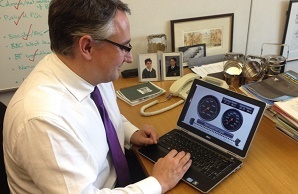
Martin testing broadband speeds.

This is particularly serious as Cheltenham had historically poor broadband speeds, some as slow as 0.5 Mbps.   Martin lobbied ministers, operators and the county council to get broadband moving for everyone.

The origins of the problem in Cheltenham date back to the 1920s when Cheltenham got a central telephone exchange.  As  the town grew, the distance from that exchange initially just meant slightly worse voice call quality. Today, internet broadband speeds drop off sharply the further you are from the exchange.  In outlying areas such as Up Hatherley and Springbank speeds can be as low as 0.5 Megabits per second (Mbps).

In today’s world, that is unacceptable which is why Martin was one of those MPs who campaigned successfully for the government to invest in superfast broadband.  A basic internet service is no longer a luxury.  We use it for:

  • Working from home
  • Access to school homework
  • Online banking
  • Applications to university
  • Job applications and benefit claims
  • Responses to Government and other public  consultations

The coalition government put more than £100 million for England into a subsidised programme to reach those areas that were not commercially viable. But by 2015 BT had only reached 88%, new estates and developments across Cheltenham were being left out and the the county council’s ‘Fastershire’ programme wasn’t filling the gaps.

The coalition government’s targets were for 90% availability of superfast broadband, with speeds as high as 25, 30 or more megabits per second, and for everyone to have the basic 2 Mbps broadband service – although the new Conservative government has quietly dropped some of these targets.  Certainly that last target was missed in Cheltenham under the Conservatives, and if they are not met in an urban area such as Cheltenham, they are unlikely to be met nationwide.

When he was the MP, Martin lobbied BT, Virgin, ‘Fastershire’ and government ministers, up to an including the Prime Minister on this issueYou can read Martin’s parliamentary speech on the issue here and watch it here.
 

Fairer society

Liberal Democrats in government locally and nationally have worked hard for a fairer society as well as a stronger economy, including tax breaks for those on low pay, delivering the pupil premium now worth a million pounds a year to Cheltenham schools and targeted at the least well-off kids, more free childcare, the first net increase in British social housing in 30 years – and the first new social housing in Cheltenham for decades.

In coalition government at national level between 2010 and 2015, the Liberal Democrats were the champions of fairness.  Many of these successful LibDem policies would never have been implemented if the Conservatives had won seats like Cheltenham and an overall majority in 2010 as they did in 2015:

  • The first £11,500 you earn is now tax-free.  By raising this allowance during the coalition, Lib Dems took 4,000 of the lowest paid Cheltonians out of income tax altogether (they had paid tax under the previous Labour government on an income of just £6,475 a year), and gave a tax break worth £800 a year to nearly 50,000 more.  LibDems still want the government to go further and make at least the first £12,500 you earn tax-free.
  • The LibDem pupil premium now pays money to schools to spend as they wish on helping the least well-off kids.  Schools facing the biggest challenges in Cheltenham now have the help they need to succeed: a quarter of a million pounds each to All Saints Academy in Hester’s Way and to Pittville School and hundreds of thousands each to primary schools like Springbank Primary, Oakwood School, Rowanfield Infants and Juniors and St Thomas More. The money has been spent on extra teaching, special support for struggling pupils, parental outreach, behavioural support, breakfast clubs and much more.

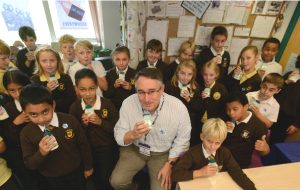
    Martin shares a healthy drink with Oakwood School pupils – just one of the many Cheltenham schools now benefitting from the Lib Dem pupil premium
  • Nick Clegg personally championed extending free childcare to 15 hours a week for all 3 and 4 year olds and least well-off 2 year olds
  • The ‘triple lock’ on the state pension increases it by earnings, prices or 2.5% whichever is the greatest.  This policy led directly to the biggest ever cash rise in the state pension and restored the link with earnings broken long ago by Mrs Thatcher.
  • Equality under the law for gay and lesbian citizens, including equal marriage.
  • The first net increase in UK council and housing association homes in 30 years – up 47,000 compared to a net loss of social housing of 420,000 under Blair & Brown’s Labour government, and a net loss of a million under the previous Tory government.
  • The historic achievement of the 40 year old target of spending just 0.7% of our national income on helping the poorest and most vulnerable people in the world.  This helped millions of Syrian refugees, a million people threatened with Ebola, 77 million kids vaccinated against measles and rubella, 120 million against polio, millions more sleeping under 9 million anti-malarial bed nets.  The 0.7% goes up or down with what the economy can afford  and right now we’re legislating for it to be fixed in law.

And not just that – we stopped the Conservatives from:

  • Introducing fire-at-will rights for employers as recommended by the Beecroft Report
  • Ditching the Human Rights Act
  • Raising the inheritance tax threshold to £1 million, giving a tax break to wealthier families
  • Introducing profit-making schools as advocated by Michael Gove
  • Introducing lower regional pay for public sector workers in regions like the west of England
  • Implementing a worse tuition fees deal for students which could have meant unlimited fees, payback at a lower pay threshold for graduates and less well-off graduates paying more
  • Making even more drastic cuts in public services and benefits

Locally, the LibDems have promoted a fairer Cheltenham too:

  • LibDem-led Cheltenham has seen the first new social housing for decades in Brighton Road and St.Paul’s and over 80 former garage sites across town – and there’s more new affordable housing planned at the Brewery and North Place and more at St.Paul’s too.
  • The LibDem council has invested over decades in neighbourhood and community projects in Hesters Way, Springbank, Whaddon and St.Paul’s, helping local regeneration and providing hubs for local clubs, services, residents’ organisations and small businesses
  • Despite big cuts to its budget, Cheltenham’s Lib Dem council froze both council tax and local car park charges for five years in a row, helping everyone’s daily cost of living
  • Martin and his casework team took up thousands of individual cases over the years as well, helping people challenge unfair laws and rules or poor decisions or treatment at the hands of companies, regulators, hospitals, councils, government ministries, colleges, schools or hospitals. All for no charge.