Better railways

Better public transport is crucial to our economy, our quality of life and our battle against climate chCheltenham Spa ange. Throughout his ten years as our MP, Martin successfully campaigned to protect local rail services and to win new investment in track and station so that the nearly two million passenger journeys that now start at Cheltenham Spa each year can be quicker and more convenient for personal, business and tourist travel.

Martin led the opposition to the Conservative-led County Council’s plan for a Gloucester Parkway station between Cheltenham and Gloucester when it became clear that it was based on taking services away from Cheltenham Spa. He was backed by environmentalists like Jonathan Porritt, local politicians of all parties and many residents and businesses in Cheltenham and Gloucester too. As a result of Martin’s campaign, the plan was shelved by the Department for Transport.

Martin has consistently backed new investment in Cheltenham Spa station and a future development that would improve parking, access for public transport and bikes, make better commercial use of the site and meet the concerns of the station’s neighbours.  Working closely with Cheltenham Borough Council and the University of Gloucestershire, he lobbied for a plan eventually supported by train operators, Network Rail and Travelwatch SouthWest and helped to get millions in funding in place by 2015.  The most ambitious version could have seen two brand new bay platforms to prevent stopping trains slowing up through services and the lower part of the car park given a second tier – but this now looks like being downgraded to a much less ambitious plan since the Conservatives took office in 2015.

Martin & LibDem transport minister Norman Baker at Cheltenham Spa Martin successfully campaigned for the redoubling of the Swindon to Kemble line. Two lines on this key route will allow more direct trains from Cheltenham to Swindon, Reading and London and give the whole region a more reliable railway service because trains will be able to overtake delayed or stopped services.

Martin personally lobbied Labour transport secretary Andrew Adonis,  Conservative ministers Teresa Villiers and Philip Hammond and finally LibDem transport minister Norman Baker to secure the £45 million spending.

Again working with Cheltenham’s Chamber of Commerce, Martin also backed a longer-term plan to build a Gloucestershire light rail network linking, Gloucester, Cheltenham town centre, the racecourse and Bishop’s Cleeve, possibly connecting with a new line to Honeybourne. This would be a convenient, reliable and low-impact network using routes like the old Honeybourne line and could connect with a restored main line north of Cheltenham, offering the prospect of a ‘heritage triangle’ train connection between Cheltenham, Stratford and Oxford.

Keeping the NHS local

Martin campaigning for local health services

It has never been more important to stand up for the local NHS.  As your local MP, Martin campaigned tirelessly for free, local health services.

Martin is married to a doctor himself and four generations of his family have been cared for by Cheltenham GPs and hospital staff so he never forgets how valuable it is to have a good local health service free to all.

Martin has campaigned for many years to defend the emergency department at Cheltenham General Hospital and to see the full overnight A&E service restored in Cheltenham.  After ‘critical incidents’ were declared at Cheltenham and Gloucester, Martin asked the NHS regulators to investigate what went wrong in Gloucestershire and what role the new 111 service played, how well the various local health and social care providers are working together (for instance when they refer patients in to A&E and allow patients to be discharged) and whether local management decisions have made the situation worse by downgrading Cheltenham A&E at night and routing all unplanned admissions through A&E.

Under the coalition, Martin refused to vote for Conservative Secretary of State Andrew Lansley’s Health & Social Care Bill which he believed broke the coalition agreement with the Liberal Democrats which promised no top-down reorganisation of the NHS. But he supported the coalition in raising overall spending on the NHS from £98bn in the last year of the Labour government to more than £110bn a year in 2015.  The Conservative government since 2015 has failed to match that rate of growth.

Far from bringing extra money into the NHS, Brexit will now put this progress at risk by damaging the economy and the so the resources available to the NHS, as well as driving away European staff and damaging recruitment.

Back in 2006, under the last Labour government, Martin was a leading member of the coalition of local campaigners that fought the 26 different cuts and closures that threatened the long-term future of Cheltenham General and many local services. Jeremy Corbyn’s supporters have a rose-tinted belief that Labour has always been a good friend of the NHS but that’s not how it felt then.

Martin led the campaign to save Cheltenham’s maternity ward

That campaign secured the future of Cheltenham’s St.Paul’s maternity ward which was earmarked for closure.  Martin will continue to campaign for the services that matter most to people, like maternity and A&E, to be kept local.

Other cuts like IVF services were also restored after pressure from Martin and others and as MP he took up many individual cases for local people who felt let down by local healthcare providers.  But he has always taken time to praise NHS staff and volunteers for their tremendous work and to give credit to local NHS management when they get things right.  Under the coalition, they managed to increase expenditure and deliver a small net surplus after achieving more than £17m in efficiency savings.

But as the chart from the independent King’s Fund below shows, in the few years since the Conservatives took power on their own, the majority of NHS trusts have plunged into deficit – and this now includes Gloucestershire too.  This is a direct threat to the future of local NHS services.NHS_into_the_red_under_Tories.png

Martin also campaigned consistently for good mental health services in Gloucestershire to make sure mental health service users get not only the services professionals think they should have but the services they want and need – just like those suffering from physical health problems.  He believes there is a particular crisis in child and adolescent mental health.  Before the coalition ended, he backed Lib Dem Deputy PM Nick Clegg’s announcement of £1.25 billion over five years for children’s mental health – but tragically this spending has not been maintained by the Conservatives since 2015.

At the 2015 General Election, only the Liberal Democrats pledged the full £8 billion extra which the NHS chief executive Simon Stevens said the NHS needed over the following five years and pledged equal status for mental health within the NHS, including children’s mental health and new mums who may need rapid access to treatment.

Flooding

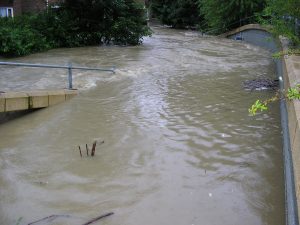
A footpath in Hesters Way in 2007

Based on the experience of 600 flooded properties in Cheltenham in the summer of 2007, Martin strongly supported a new national deal on flood insurance and responsibility for drainage and extensive government-funded flood defence work in Cheltenham and elsewhere, but also a more sustainable approach to naturally holding water in the landscape, for instance by extensive tree-planting and landscape management.

Martin was home in Cheltenham when the June and July 2007 floods hit. Although he had to rescue his own children from a flooding car and lost his water supply along with the rest of us, he escaped lightly compared to many constituents who were left homeless or had their business premises wrecked or lost priceless possessions in the waters. Martin has repeatedly acknowledged the debt we all owe to the emergency services, the army, the environment agency and local council and NHS staff.

During the passage of the Floods and Water Management Act 2010, Martin was the Liberal Democrat spokesperson on flooding. He won a series of concessions from ministers and tabled many amendments to the bill calling for changes that have been highlighted by people in Cheltenham since the floods in 2007:

  • more steps to protect critical infrastructure like the Mythe water treatment works and Walham electricity sub-station
  • clearer responsibility for flood prevention including clearing and maintaining culverts, drains and small rivers and all forms of flooding
  • encouraging flood management that works with nature, for instance using land management and woodland to hold back water uphill not just expensive flood defences in our towns

On two key votes pressed by Martin, the Conservatives (including the current MP for Tewkesbury) failed to support him and his amendments were voted down which would have promoted fairer insurance policies and given local authorities clear powers to refuse planning permission in flood risk areas where overdevelopment can make matters worse.

Martin helping out with fresh water supplies in Oakley in 2007

After the 2010 Act, the coalition government struck a new national deal with the insurance industry called Flood Re to secure affordable insurance for all. Martin welcomed Flood Re but still wants government to actively monitor the affordability and availability of flood insurance, which has affected many people in Cheltenham since 2007. The coalition also strengthened planning guidance relating to flooding in the new National Planning Policy Framework although, again, Martin believes this could go further.

Flood defences need to work with nature. Martin has also consistently called for more funding for anti-flooding works. Cheltenham’s multi-million pound scheme including Cox’s Meadow did hold back 75,000 litres of flood water and more work was later done by the Environment Agency to the River Chelt and adjacent areas and by Severn Trent to sewers and drainage all over town, including Warden Hill.

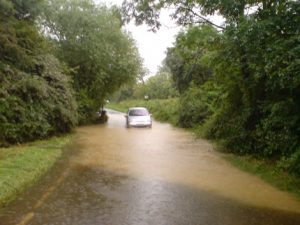
Martin’s own car stranded in the 2007 floods in Leckhampton

Anyone concerned about flooding can find the latest information on the Environment Agency website or by following @EnvAgencyMids on Twitter.

They can also sign up to Flood Alerts via the Flood Alerts Facebook App   http://www.facebook.com/FloodAlerts or by calling the Environment Agency Flood Line on 0345 988 1188 or 0845 988 1188.

Experts fear global warming will mean extreme flood events will be much more common in future. So we have to take every step we can to reduce the risks from flooding and avoid making it worse.

Fighting crime

As an MP, Martin strongly defended a well-funded local police force, called for smart sentencing and innovative approaches like restorative justice to cut re-offending and involve victims more in the justice process.

There were more than 7,000 recorded crimes in Cheltenham in Martin’s last full year as an MP – still far too many but more than 27% less than in 2010.  Domestic burglary, drug offences, bicycle theft, public order offences, possession of weapons offences and vehicle offences were all sharply lower then in Cheltenham than they were in 2010.  This is a tribute to Cheltenham people including Neighbourhood Watch volunteers, to Gloucestershire Constabulary‘s effective community policing and preventive work and to innovative projects like the Aston Project and the Halt project who have worked to reduce the risk of offending amongst young people.

Martin backs community-based policing

Martin criticised Conservatives on the old Police Authority for refusing funding for our police which would have avoided cuts and regrets the cuts now being faced again on the watch of a Conservative Police & Crime Commissioner.

Gloucestershire Constabulary has a strong record of community-based policing and effective action against crime – including anti-terrorist arrests like the Gloucester ‘shoe bomber’ Richard Reid and clampdowns on organised crime families. The force’s finest hour was their emergency leadership role during the 2007 floods.  Under the last Labour government there was a serious plan to wind up local police forces like ours and set up a centralised south west England police force.  Martin was one of many MPs who lobbied strenuously against this plan which was duly dropped as unworkable and unaffordable.

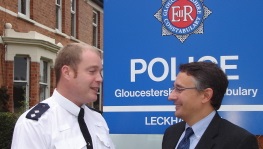
Seeing_town_centre_policing_first_hand_bw.jpg

Martin has been a critical friend of the police when necessary, pointing out problems emerging in outlying areas of town like Warden Hill, Hatherley and Springbank that needed nipping in the bud. He strongly supported the force’s move towards more community-based policing and also highlighted residents’ and tenants’ concerns about crimes on specific estates around town and the time it sometimes seem to take for the police and other authorities to take action against anti-social behaviour.

Martin has also supported honest sentencing – so that life really means life – and smarter sentencing – leaving proper discretion to juries, judges and magistrates but offering the alternative of ‘restorative justice’ involving victims more in setting the punishment.  Gloucestershire is already a leader in this novel approach which promises lower re-offending rates and puts victims at the heart of the justice process.

Martin also supports tough community payback schemes to make community sentences fit the crime and innovative projects like Cheltenham’s Aston Project and Halt project which offer positive alternatives to young people at risk of getting into trouble.  Early results suggested they could have a dramatic effect on offending rates.

A stronger economy – locally and nationally

In 2015, after five years with the Lib Dems in government locally and nationally, Cheltenham was enjoying its strongest economy in years with a big drop in unemployment, local businesses reporting healthy order books and both businesses and householders still enjoying low interest rates and mortgage payments.  As MP, Martin backed both the coalition government and Cheltenham’s LibDem-led council in taking the tough decisions necessary to build sustainable prosperity and worked hard to lobby for and promote local business.

All this is now at risk from the Conservatives’ suicidal drive towards ‘Brexit’ which could could see the UK drop out of the world’s largest single market like a crate of eggs out of the back of a lorry.  The Conservatives’ initial arrogance and aggressive approach towards the EU negotiations and their chaotic and unco-ordinated approach to Brexit generally is undermining business confidence further.

Click on the image to watch Martin working for local business when he was MP: opening the new Chamber of Commerce business centre

Back in 2010, the new coalition government inherited a massive financial crisis from the last Labour government.  Whoever you blame, the situation in the 2009/10 financial year was that:

  • Government was spending £153 billion pounds* a year more than it was raising
  • This represented 10.2%* of GDP (the value of the economy)
  • If this hadn’t been brought under control, our economy would quickly have gone the way of Greece and others and our interest rates – which set the cost of borrowing by businesses as well as your mortgage – might have skyrocketed, doing serious damage to the economy, increasing the cost of living for homeowners and throwing millions out of work
  • Unemployment in Cheltenham was already 2251 or  4.5%**, the highest in years
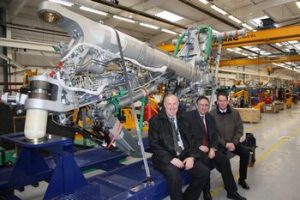
Martin at Safran (then Messier-Bugatti-Dowty)

To strengthen the economy, Martin and the Liberal Democrats backed the tough decisions – opposed by Labour – which did bring public spending under control, reduced that overspend by a third and reassured financial markets so that business borrowing and mortgage rates in Cheltenham were kept low as we fought off recession. By 2015:

  • Government overspending was expected to be £91.3 billion*, still very high but down by a massive £61 billion a year
  • This represented 5% of GDP* – half the value it was five years previously
  • The economy was the fastest growing economy of any of the G7 group of major economies, growing 2.6% in 2014/15 and it was estimated to keep growing at 2.5% a year – until the disastrous Brexit vote
  • Earnings were finally starting to go up too.  Together with the fall in fuel prices, this helped everyone by bringing the cost of living down this year.  The Office of Budget Responsibility confirmed living standards were higher in 2015 than they were in 2010.
  • Unemployment in Cheltenham fell to 854 or just 1.6%** Under the coalition, the UK had the strongest employment growth in the G7.  The number of young people claiming unemployment benefits was at its lowest since the 1970s.

Sources: * Office of Budget Responsibility 2014/15 ** Department of Work & Pensions

But a stronger economy isn’t just a fast-growing one – it must be sustainable too:

  • The coalition launched the world’s first Green Investment Bank and locked investment in low-carbon energy into energy markets through the Energy Act and has created a record number of green jobs. In Cheltenham, Martin has backed local companies like Tidal Lagoon Power and Commercial who have pioneered sustainable jobs and business
  • The coalition created more than 2 million new apprenticeships, 2,610 of them in Cheltenham, building skills for the future
  • Whether we were still in recession or growing again, the coalition kept investing in infrastructure, maintaining spending on public transport and committing another £6 billion investment to flood defences, including more flood defence work in Cheltenham to protect another 240 properties
  • The coalition committed to the largest ever sustained investment in Britain’s science base, including a £2.9 billion Grand Challenges fund to enable the UK to invest in major research facilities.  This progress is now particularly at riosk from Tory Brexit plans.

The economy was stronger locally too.  Cheltenham’s LibDem council faced cuts along with other local authorities –  their net budget fell in cash terms by about 12% over seven years, from £16.1m to £14.2m – but despite the cuts, there was no crisis at Cheltenham Borough Council:

  • £8.5m was found in savings and additional income and ‘austerity’ has had little impact on frontline services. Savings have been made by radical management efficiencies, sharing back office functions and major functions like waste collection with other councils, and turning arts and leisure management over to a charitable trust of which Martin is now an unpaid trustee.
  • Martin and the borough council worked together to win major new investment in developments like the Brewery, North Place and in local transport, including £5m for local sustainable transport, £45m for the redoubling of the Swindon/Kemble line to improve services  to Swindon, Reading and London and an ambitious plan to upgrade parking, access and facilities at Cheltenham Spa station which has now won widespread backing.

In stark contrast, The Conservative-led county council has lurched from crisis to crisis – taken to court over its library closures, signing up to a wasteful incinerator contract turned down by its own councillors then forced through by the administration, slapping new on-street parking charges on small business areas and leaving our roads in a total mess.

Martin on a return visit to the Cheltenham business where he worked before being elected MP

As MP, Martin lobbied for and promoted local companies from publisher Edward Elgar to worldbeating clothes retailer SuperDry, from engineering firms like Spirax Sarco, DIS and CF Roberts to IT firms like Innov8ive software.  He worked with business organisations like the Chamber of Commerce, Gfirst LEP and Cheltenham Connect to promote and support local business.

He promoted Cheltenham’s Festivals in Parliament with an eye to drawing even more valuable visitors to the town and encouraged council backing for areas like the Lower High Street that deserved more support.  He supported a more determined strategy to market Cheltenham to visitors, investors and relocating businesses which has now happened with the recent creation of Marketing Cheltenham.

Cheltenham EU citizens deserve right to remain

Cheltenham’s Liberal Democrat parliamentary candidate Martin Horwood has called on the government to accept their defeat in the Lords on Wednesday and accept the right of EU citizens already in this country to remain after Brexit.

Speaking to a meeting of Cheltenham’s Polish Tenants & Residents Association earlier this week he strongly condemned the government’s plan not to guarantee the right to remain of citizens of other EU countries until reciprocal rights for British citizens in the rest of the EU had been secured as part of the ongoing Brexit negotiations – ‘as soon as they can’.

“Those negotiations could drag on for many years and agreement might never be reached” Martin told the TARA. “Yet the government could sort this tomorrow if it wanted.  It is just immoral to use people as bargaining chips in this way. People have lived here for years and have always been told they had the right to remain here.  They have jobs, families, children that can’t simply be uprooted. They are working hard, paying taxes and keeping the NHS and care sector functioning.  No-one imagines that a sane British government would actually deport them on the day we leave the European Union but employers and landlords and banks would start to ask for evidence of their right to live and work in the UK and make life more and more difficult.  Yet it is entirely within the power of the UK government to guarantee their right to remain regardless of the negotiations.”

Cheltenham is thought to have thousands of citizens of other EU countries living and working here, including in the NHS and in local technology companies.  Martin Horwood criticised Theresa May’s hardline stance on this issue during the Conservative leadership contest last year (http://www.gloucestershirelive.co.uk/martin-horwood-criticises-theresa-may-over-eu-citizens-stance/story-29478677-detail/story.html).  The TARA meeting heard many Polish Cheltonians complain about the uncertainty the row had suddenly caused them and how current Home Office systems to grant permanent leave to remain were simply not set up for people who had always had that right and never before needed documentary proof of permanent residence.

Following Wednesday’s House of Lords vote Martin Horwood added: “The House of Lords have shown the government the way by amending the Brexit bill to guarantee EU citizens’ right to remain.  The government should accept this defeat gracefully and do the right thing for our European friends, neighbours, family members and workmates.  The House of Lords isn’t seeking to stop Brexit, just impose some moderation and humanity on the process.  The government should follow their Lordships’ lead and make the guarantee now.”

Stopping climate change

Martin has campaigned tirelessly at local, national and European level for tougher action to stop climate change – and for smart planning for the inevitable effects of climate change too.

As an MP, he was a member of the Aldersgate Group which brings together leading MPs, businesses and green organisations committed to fighting climate change and was on the advisory board of the Energy & Climate Change Information Unit which actively promotes accurate and accessible facts about climate change in the UK media. As his party’s shadow environment minister, he jointly tabled the amendment to the 2008 Climate Change Bill that raised the UK carbon emission reduction ambition by 2050 from 60% to 80% and helped to develop Liberal Democrat policy that went much further and aimed for Zero Carbon Britain – a policy which other parties are gradually, painfully catching up with only now.  He opposed new coal-fired power stations, supported a moratorium on fracking and spoke out in parliament in favour of more wind, tidal, solar and other renewable forms of energy.

As an MEP, Martin raised climate issues on everything from trade to transport. He voted for the European Parliament’s declaration of a climate emergency and for the Green New Deal for the whole of Europe brought forward by his liberal renew Europe colleague Pascal Canfin MEP.  Watch short videos from Martin as MEP on EU policy affecting rainforests here, on local renewable energy here and on trade deals that support climate action here.  It is tragic that Brexit cut off our participation in climate initiatives like these when climate change is so obviously a challenge that one country can’t possibly tackle alone.

As a Cheltenham councillor, Martin has backed Cheltenham’s Lib Dem council in its declaration of a climate emergency here and its plan to get Cheltenham to Net Zero by 2030.  He worked on the plan to get all Cheltenham’s taxis to zero carbon by then and pushed for all new private sector housing to be zero carbon. Cheltenham’s very first zero carbon private sector homes were built in Leckhampton and the new development along the Shurdington Road will also have solar panels and air source heat pumps built in from the start.

Martin was proud that LibDems in the coalition government achieved great progress on the environment:

  • the biggest carbon dioxide reduction on record for a growing UK economy
  • the world’s first Green Investment Bank
  • investment in low-carbon energy locked into UK energy markets through the Energy Act
  • 200,000 green jobs
  • a million trees planted
  • renewable energy generation in the UK more than doubled with solar energy generation going up 60% just in the last year

Environmental policy went into reverse when the  Conservatives took power on their own in 2015. Support for renewables was cut, the Green Investment Bank sold off, targets for electric cars were axed, the energy efficiency Green Deal plan scrapped with no replacement, green lights given to new coal and oil exploitation and greenhouse gas targets missed. And they kept putting back the target for all new homes to be zero carbon – the coalition set the date at 2016 so every new home built in the UK for the last seven years would have been climate-friendly. The new Labour government has improved the situation on some fronts but is also threatening to tear up environmental protections in the name of economic growth and has given the go-ahead to the long-opposed new runway at Heathrow.

Martin has consistently spoken out for tougher action both to stop making climate change worse but also for adapting to the now inevitable impacts of climate change.  You can watch Martin’s 2014 speech to the national Lib Dem conference here.

As a result of his efforts for the environment, Green Liberal Democrats elected Martin as their President, a position he still holds today.

Protecting animals

Martin was President of Cheltenham & East Gloucestershire RSPCA and a member of the all-pFox arty parliamentary group for animal welfare when he was an MP.

As a cabinet member on Cheltenham Borough Council he brought forward a robust new animal welfare charter including a ban on the use of live animals in circuses or as prizes on council land.

Martin has been actively promoting the welfare of animals in the UK and abroad for years.  He opposes repeal of the hunting ban and supports the continued ban on hunting on Cheltenham Borough Council land. He called for an end to commercial whaling and successfully supported legislation in parliament to ban wild animals in circuses and to introduce universal microchipping of dogs.

He consistently opposed the Gloucestershire badger cull and supported alternative approaches to keep both badger and cattle populations healthy as advocated by Gloucestershire Wildlife Trust.

As an MP he was voted Animal Welfare Champion 2009 by his parliamentary colleagues of all parties.  He was nominated by Cheltenham charity Naturewatch.

Martin microchipping back in 2008 Martin was one of the leading MPs to successfully promote the routine microchipping of dogs, now a cheap and easy technology that will identify many of the 100,000 dogs dumped and lost each year in the UK. The coalition government made this compulsory. It has helped local authorities, charities like Cheltenham Animal Shelter and the police to correctly identify the owners of both lost and dangerous dogs and take firmer action. Martin also supported moves in Parliament to extend restrictions on the docking of puppies’ tails.  Locally, he strongly supported Cheltenham Animal Shelter and particularly its innovative Halt project which helps humans as well as animals.  Martin also pressed for reform of dangerous dogs legislation which has now shifted the emphasis away from a list of obscure breeds – often difficult to identify – towards a focus on dangerous behaviour and the poor ownership that causes it.

He also strongly supported the ban on wild animals in circuses which was passed into law by the coalition government .

Martin opposes repeal of the Hunting Act and was targeted by pro-hunting Martin welcomes the tail of a whale to Westminsteractivists in both the 2015 and 2017 General Elections as a result.  They moved hunt supporters in from the Cotswolds in both elections to support the Conservative candidate Alex Chalk who nevertheless repeatedly refused to say where he stood on the ban.
Martin strongly backed the international ban on whaling and met with the Japanese ambassador as part of the campaign to persuade Japan to drop its remaining hunting of these intelligent mammals in the name of ‘research’. He tabled motions in Parliament criticising Canada’s seal hunt and calling for a Europe-wide ban on commercial seal products.

As shadow environment minister in the 2005-10 parliament, he was a strong supporter of the Marine Act 2009 that helped to protect fish stocks for future generations and added to the protection for vulnerable marine birds like the puffin. He supported calls for new marine reserves around British overseas territories and tougher action to stop illegal birdhunting on the UK’s sovereign bases in Cyrprus.

He backed national campaigns like the RSPCA’s Freedom Food standard that promote animal welfare.

key_Martin_and_friend_support_the_Marine_Bill-small.jpg

Martin also worked with local Cheltenham-based charity Naturewatch to oppose all animal testing for cosmetics and promote the ‘3Rs’ in animal research – reduction, replacement and refinement. This approach seeks to promote alternatives to animal research, eradicate unnecessary use of animals and improve animal welfare where research continues.  Another Naturewatch campaign has succeeded – during the coalition, LibDem minister Lynne Featherstone confirmed the government would ban the testing on animals of ingredients used in household products, a pledge included in the 2010 Coalition agreement

Better broadband for Cheltenham

Cheltenham has undergone a broadband revolution in the last few years.  By 2015 at least 88% of the town was able to upgrade to superfast fibre-optic broadband with speeds of 35 Megabits per second (Mbps) or faster.  But it had also become clear by then that thousands of homes in Cheltenham were going to be left out of this revolution. Gaps were being left between the commercial operators like BT and Virgin and the government-subsidised ‘Fastershire’ programme being run by the county council. 

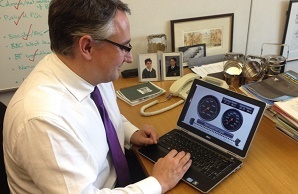
Martin testing broadband speeds.

This is particularly serious as Cheltenham had historically poor broadband speeds, some as slow as 0.5 Mbps.   Martin lobbied ministers, operators and the county council to get broadband moving for everyone.

The origins of the problem in Cheltenham date back to the 1920s when Cheltenham got a central telephone exchange.  As  the town grew, the distance from that exchange initially just meant slightly worse voice call quality. Today, internet broadband speeds drop off sharply the further you are from the exchange.  In outlying areas such as Up Hatherley and Springbank speeds can be as low as 0.5 Megabits per second (Mbps).

In today’s world, that is unacceptable which is why Martin was one of those MPs who campaigned successfully for the government to invest in superfast broadband.  A basic internet service is no longer a luxury.  We use it for:

  • Working from home
  • Access to school homework
  • Online banking
  • Applications to university
  • Job applications and benefit claims
  • Responses to Government and other public  consultations

The coalition government put more than £100 million for England into a subsidised programme to reach those areas that were not commercially viable. But by 2015 BT had only reached 88%, new estates and developments across Cheltenham were being left out and the the county council’s ‘Fastershire’ programme wasn’t filling the gaps.

The coalition government’s targets were for 90% availability of superfast broadband, with speeds as high as 25, 30 or more megabits per second, and for everyone to have the basic 2 Mbps broadband service – although the new Conservative government has quietly dropped some of these targets.  Certainly that last target was missed in Cheltenham under the Conservatives, and if they are not met in an urban area such as Cheltenham, they are unlikely to be met nationwide.

When he was the MP, Martin lobbied BT, Virgin, ‘Fastershire’ and government ministers, up to an including the Prime Minister on this issueYou can read Martin’s parliamentary speech on the issue here and watch it here.


Fairer society

Liberal Democrats in government locally and nationally have worked hard for a fairer society as well as a stronger economy, including tax breaks for those on low pay, delivering the pupil premium now worth a million pounds a year to Cheltenham schools and targeted at the least well-off kids, more free childcare, the first net increase in British social housing in 30 years – and the first new social housing in Cheltenham for decades.

In coalition government at national level between 2010 and 2015, the Liberal Democrats were the champions of fairness.  Many of these successful LibDem policies would never have been implemented if the Conservatives had won seats like Cheltenham and an overall majority in 2010 as they did in 2015:

  • The first £11,500 you earn is now tax-free.  By raising this allowance during the coalition, Lib Dems took 4,000 of the lowest paid Cheltonians out of income tax altogether (they had paid tax under the previous Labour government on an income of just £6,475 a year), and gave a tax break worth £800 a year to nearly 50,000 more.  LibDems still want the government to go further and make at least the first £12,500 you earn tax-free.
  • The LibDem pupil premium now pays money to schools to spend as they wish on helping the least well-off kids.  Schools facing the biggest challenges in Cheltenham now have the help they need to succeed: a quarter of a million pounds each to All Saints Academy in Hester’s Way and to Pittville School and hundreds of thousands each to primary schools like Springbank Primary, Oakwood School, Rowanfield Infants and Juniors and St Thomas More. The money has been spent on extra teaching, special support for struggling pupils, parental outreach, behavioural support, breakfast clubs and much more.

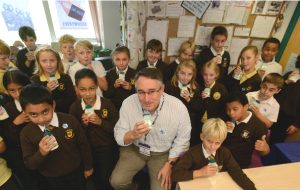
    Martin shares a healthy drink with Oakwood School pupils – just one of the many Cheltenham schools now benefitting from the Lib Dem pupil premium
  • Nick Clegg personally championed extending free childcare to 15 hours a week for all 3 and 4 year olds and least well-off 2 year olds
  • The ‘triple lock’ on the state pension increases it by earnings, prices or 2.5% whichever is the greatest.  This policy led directly to the biggest ever cash rise in the state pension and restored the link with earnings broken long ago by Mrs Thatcher.
  • Equality under the law for gay and lesbian citizens, including equal marriage.
  • The first net increase in UK council and housing association homes in 30 years – up 47,000 compared to a net loss of social housing of 420,000 under Blair & Brown’s Labour government, and a net loss of a million under the previous Tory government.
  • The historic achievement of the 40 year old target of spending just 0.7% of our national income on helping the poorest and most vulnerable people in the world.  This helped millions of Syrian refugees, a million people threatened with Ebola, 77 million kids vaccinated against measles and rubella, 120 million against polio, millions more sleeping under 9 million anti-malarial bed nets.  The 0.7% goes up or down with what the economy can afford  and right now we’re legislating for it to be fixed in law.

And not just that – we stopped the Conservatives from:

  • Introducing fire-at-will rights for employers as recommended by the Beecroft Report
  • Ditching the Human Rights Act
  • Raising the inheritance tax threshold to £1 million, giving a tax break to wealthier families
  • Introducing profit-making schools as advocated by Michael Gove
  • Introducing lower regional pay for public sector workers in regions like the west of England
  • Implementing a worse tuition fees deal for students which could have meant unlimited fees, payback at a lower pay threshold for graduates and less well-off graduates paying more
  • Making even more drastic cuts in public services and benefits

Locally, the LibDems have promoted a fairer Cheltenham too:

  • LibDem-led Cheltenham has seen the first new social housing for decades in Brighton Road and St.Paul’s and over 80 former garage sites across town – and there’s more new affordable housing planned at the Brewery and North Place and more at St.Paul’s too.
  • The LibDem council has invested over decades in neighbourhood and community projects in Hesters Way, Springbank, Whaddon and St.Paul’s, helping local regeneration and providing hubs for local clubs, services, residents’ organisations and small businesses
  • Despite big cuts to its budget, Cheltenham’s Lib Dem council froze both council tax and local car park charges for five years in a row, helping everyone’s daily cost of living
  • Martin and his casework team took up thousands of individual cases over the years as well, helping people challenge unfair laws and rules or poor decisions or treatment at the hands of companies, regulators, hospitals, councils, government ministries, colleges, schools or hospitals. All for no charge.